Staggered tire fitment: when front and rear sizes may differ
Use the same size on all four corners unless the vehicle maker specifies a staggered setup, and never mix passenger and light-truck types on one vehicle.
Last updated: November 11, 2026
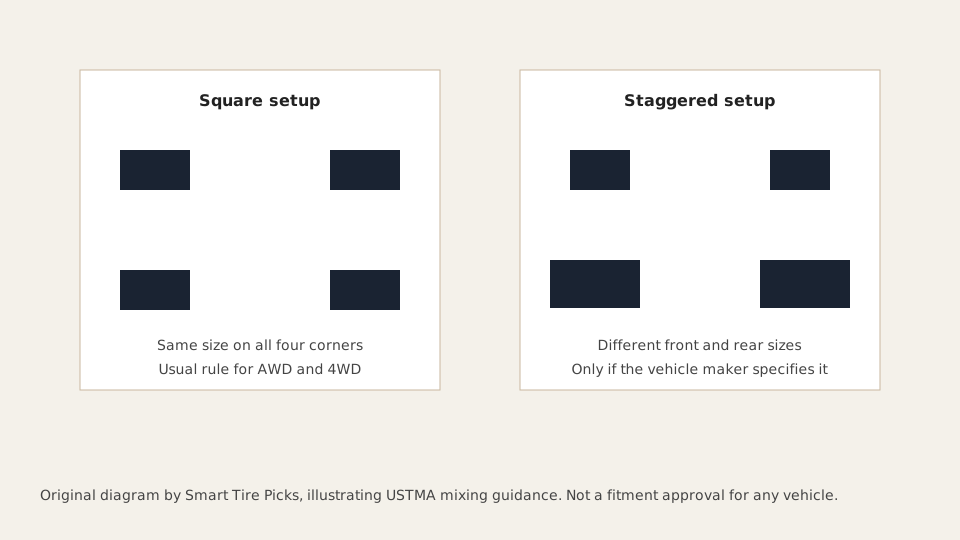
Default to one size, unless the vehicle says otherwise
USTMA's standard practice is that replacement tires should be the same size, inflation pressure, load-carrying capacity and speed rating as the vehicle tire placard. It is recommended that all four tires be the same size, load index, speed rating and construction. In some cases the vehicle manufacturer requires different sized tires on the front and rear axles. That factory staggered setup is the exception, not a licence to invent a stagger on a vehicle that came square.
Always follow the owner's manual and the placard. USTMA also says to match tire size designations in pairs on an axle, except for temporary use of a spare. Never mix P-metric or metric passenger tires with light-truck tires, including C-type European commercial tires, on the same vehicle.
AWD, 4WD and circumference
If the owner's manual has no mixing instructions, USTMA's guidelines for four-wheel drive and all-wheel drive vehicles are: do not mix tire sizes (all four must be marked with the same tire size unless the vehicle manufacturer specifies otherwise, and that also applies to winter or snow tires); do not mix radial and non-radial tires; and do not mix tread pattern types such as all-terrain and all-season. Even small diameter differences can matter on these drivetrains. If you do change size, USTMA says the outside circumference of all four tires must stay within the vehicle manufacturer's accepted tolerance, because differences can affect handling, ABS, TPMS, 4WD or AWD systems and other electronics.
Directional and asymmetric tires add their own rotation limits, and a staggered axle usually cannot be rotated front to rear. See directional and asymmetric fitment and tire rotation patterns.
Shop checks before you mount
- Copy the placard sizes for each axle, including any different front and rear lines, and the specified cold pressures. See the tire placard guide.
- If the vehicle is staggered from the factory, replace with those axle sizes or another combination the vehicle or tire maker lists. Do not square up or stagger a car without that guidance.
- On AWD and 4WD vehicles, refuse a mixed-size set unless the manufacturer specifies it.
- Confirm each tire's load-carrying capacity and speed rating meet or exceed the original requirement, and that each tire is going on an approved rim width of the correct diameter.
- If a non-OE size needs a higher inflation pressure to carry the load, USTMA says the installer should tell the owner and place a sticker next to the placard with the new size and pressures. Never inflate below the placard pressure, and never above the maximum on the sidewall.
FAQ
What is staggered tire fitment?
It is a vehicle setup that uses different tire sizes on the front and rear axles, usually a wider rear tire. USTMA says some vehicle manufacturers require different sizes front and rear. That is the case where a stagger is appropriate. The default recommendation is still the same size, load index, speed rating and construction on all four tires.
Can I run different size tires on the front and rear of an AWD car?
Only if the vehicle manufacturer specifies it. If the owner manual has no mixing instructions, USTMA says all four tires on a 4WD or AWD vehicle must be marked with the same tire size, and that this also applies to winter or snow tires. Even small diameter differences can affect those drivetrains.
Can I mix passenger tires and LT tires on the same vehicle?
No. USTMA says never mix P-metric or metric passenger tires with light-truck tires, including C-type European commercial tires, on the same vehicle. It also recommends matching size designations in pairs on an axle, except for temporary use of a spare.
Do staggered tires rotate front to back?
Usually not. Different front and rear sizes, and many directional or asymmetric tread patterns, restrict rotation. Follow the vehicle maker rotation diagram and our tire rotation and directional fitment guides rather than a standard cross pattern.
What if only two tires are being replaced on a staggered car?
USTMA prefers replacing all four tires at the same time. If that is not feasible, follow the vehicle manufacturer instructions first. As a general rule, match size designations in pairs on an axle, and do not create a new stagger or a mixed type. Some manufacturers advise against replacing fewer than all four tires.
Should I change the placard pressure on a staggered replacement?
Keep any front and rear pressure difference shown on the placard. If a new size needs a higher inflation pressure to carry the load, USTMA says the installer should inform the owner and add a sticker next to the placard with the new size and pressures. Never inflate below the placard pressure, and never above the sidewall maximum.
Sources
- USTMA, Care and Service of Passenger and Light Truck Tires (2017 PDF): same-size default, factory different front and rear sizes, no mixing of passenger and LT tires, AWD and 4WD mixing guidelines, circumference tolerance, and installer pressure stickers
- USTMA, Care and Service of Passenger and Light Truck Tires (resource page): landing page for the same manual
- Image policy: how diagrams and photographs on this site are credited