ST trailer tires: markings, load and why not to swap types
If the sidewall says ST, USTMA treats that tire as a special trailer tire with its own load characteristics. It should not be replaced with a passenger or light-truck tire.
Last updated: November 12, 2026
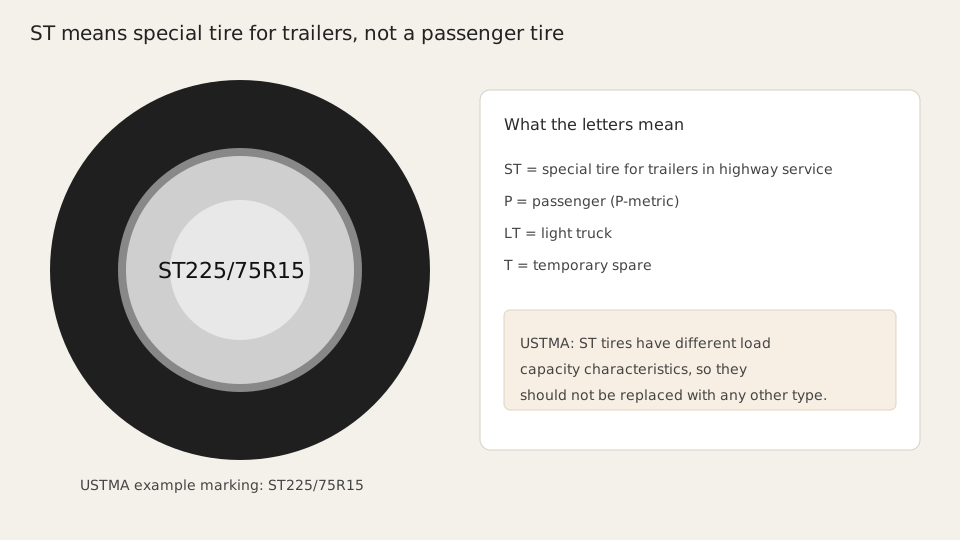
Trailer tires are easy to mix up with passenger or light-truck sizes that look similar on the rack. The U.S. Tire Manufacturers Association's Care and Service of Passenger and Light Truck Tires manual (2017) is the source for the ST rules on this page. It also covers RV load and inflation. Follow the trailer or vehicle certification label and the tire sidewall; this page is a summary, not a load calculation for a specific rig.
How to recognize an ST tire
The care manual's size-designation list includes "ST Special Tire for Trailers." The letters mean: P for P-metric passenger, LT for light truck, C for European commercial light duty, ST for special tire for trailers, and T for a temporary spare. In the RV chapter, USTMA says tires specifically designed for travel trailer use in highway service have an "ST" molded on the tire sidewall, such as ST225/75R15. See also how to read a tire size.
Do not replace an ST tire with another type
The same paragraph is direct: ST tires have different load capacity characteristics. Therefore, ST tires should not be replaced with any other type tire. That rules out fitting a passenger P-metric or an LT tire in place of an ST size just because the section width looks close. Choose a replacement that matches the trailer's specified size and load capacity, and have it mounted by a professional. For valves on higher-pressure ST assemblies, see valve stems and caps.
Load and inflation on a trailer or RV
To avoid overloading RV tires, USTMA says to maintain the proper inflation pressure and never exceed the vehicle's Gross Axle Weight Ratings (GAWR) or Gross Vehicle Weight Rating (GVWR) on the certification label. The load must also be distributed so that no individual axle, tire or dual assembly is overloaded. The maximum load for each tire, and the maximum inflation pressure for that load, are molded on the sidewall. Never exceed the stated maximum limits on the tire, rim or wheel assembly.
The manual also warns that a GAW figure can give a false sense of security: the total on an axle may be within the rating while one side is still overloaded. Tongue weight, the downward force at the hitch or fifth-wheel connection from a fully loaded trailer, is supported by the towing vehicle's tires, not by the trailer's tires.
Recommended inflation pressures for RV tires are on the vehicle tire placard, the certification label, or in the owner's manual. Never set pressures below that recommended figure. Underinflation causes excessive heat build-up and internal structural damage that may lead to a tire failure, even at a later date. Do not exceed the maximum inflation pressure shown on the tire sidewall. Overinflated tires, above that sidewall maximum, are more likely to be cut, punctured or damaged by a sudden impact such as a pothole. To maintain the correct pressure, USTMA says to check regularly with a dual-head pressure gauge calibrated up to 120 psi in at least 2 psi increments. For ordinary vehicle inflation practice, see tire pressure.
FAQ
What does ST mean on a tire sidewall?
USTMA's care manual lists ST as a special tire for trailers. In the RV chapter it says tires designed for travel trailer use in highway service have ST molded on the sidewall, and it gives ST225/75R15 as an example.
Can I put passenger or LT tires on a trailer that came with ST tires?
USTMA says ST tires have different load capacity characteristics and therefore should not be replaced with any other type tire. Use the size and capacity specified for the trailer.
Where should I set the pressure on ST or RV tires?
The care manual says to use the recommended inflation on the vehicle tire placard, certification label or owner's manual, never below that figure and never above the maximum molded on the sidewall. For RV tires, it recommends checking with a dual-head gauge calibrated up to 120 psi in at least 2 psi increments. Never exceed the trailer's GAWR or GVWR.
Sources
- USTMA Care and Service of Passenger and Light Truck Tires (2017): ST size designation, the instruction not to replace ST tires with any other type, and the RV chapter on GVWR, GAWR, tongue weight, inflation limits and a 120 psi gauge. The manual was read on 12 November 2026.
- Image policy: how diagrams and photographs on this site are credited