Tire valve stems and caps: when to replace them
USTMA says to replace used snap-in valves when you replace tires, keep a sealing cap on the stem, and match the valve to the assembly's maximum pressure.
Last updated: November 11, 2026
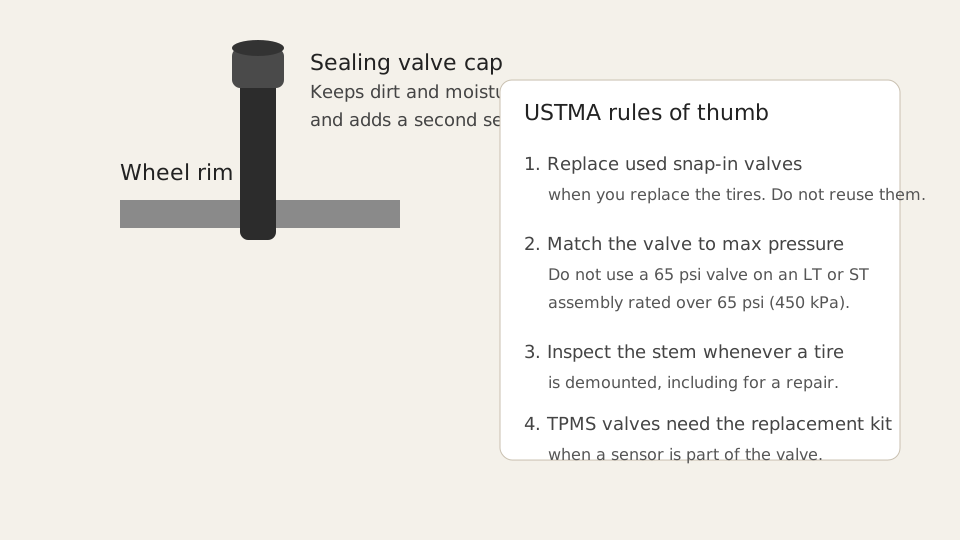
The valve stem is a small part with a large job: it is the path air uses to enter and leave the tire, and a weak or wrong valve can release that air suddenly. The U.S. Tire Manufacturers Association covers valves in its Care and Service of Passenger and Light Truck Tires manual (2017) and in Tire Information Service Bulletin Volume 40, Number 5 (August 2023). This page summarizes those official documents for passenger and light-truck work. It is not a full mounting or valve-installation procedure, and it is not a substitute for the valve, tire or wheel manufacturer when a rating is unclear.
Replace snap-in valves when you replace the tires
USTMA's care manual and TISB 40 both say to always remove and replace used snap-in valves when replacing tires, and never to reuse snap-in valves. Use only valves that are compatible with the rim being serviced. Any time a tire is demounted for any reason, including a repair, inspect the valve stem for damage such as cracks or tears to decide whether it should be replaced.
The care manual's RV chapter also states, as a general note, to install a new valve assembly whenever a tire is replaced, and that rubber valve stems must always be replaced when tires are replaced. Treat a tire change as a valve-service job, not as a chance to keep the old snap-in stem.
Always fit a sealing cap
Both documents say to always cover the valve stem with a sealing valve cap. That helps keep moisture, dirt and other contaminants out of the valve core and provides an additional seal. For RV applications, which often run at higher pressures, the care manual recommends metal valve caps with rubber seals because a plastic cap may not provide the same seal.
Match the valve to the assembly's maximum pressure
TISB 40 is direct: use a valve that matches the maximum inflation capability of the tire and wheel assembly. Do not use a valve rated for a maximum of 65 psi (450 kPa) on an assembly, such as a light-truck "LT" or special trailer "ST" tire, that is rated for more than 65 psi. A high-pressure valve must be used when inflation pressure exceeds 65 psi. If the wrong valve is fitted, TISB 40 says it may detach and cause a sudden loss of inflation pressure.
The bulletin also notes that valve pressure ratings can vary by manufacturer, so the maximum rating should be verified with the valve maker before installation. Examples in TISB 40 include common snap-in valves rated to 65 psi (often with a rounded base), high-pressure snap-in valves rated up to 80 psi or 100 psi (square base contour), and clamp-in metal valves rated up to 200 psi. Metal valve extensions are not to be used with snap-in valves; extensions typically found on dual-wheel applications require a clamp-in valve. For performance applications above 130 mph (210 km/h), TISB 40, citing the Tire and Rim Association, recommends a clamp-in valve instead of a snap-in valve. The care manual likewise says that for inflation pressures above 65 psi a high-pressure valve must be used.
TISB 40 includes a snap-in installation procedure for tire service professionals (debur the valve hole, lubricate standard snap-in valves but not high-pressure snap-in valves, pull the stem until the indicator ring clears the weather side of the rim, then inspect for damage). That procedure belongs on the shop bench with the bulletin in hand. This page does not repeat it as a standalone how-to.
TPMS valves are a kit, not just a stem
Some assemblies have a tire-pressure monitoring sensor attached to, or part of, the valve. USTMA says that when new tires are installed it is recommended to replace all components included in the TPMS valve replacement kit. Whenever the sensor is disassembled for any reason, install a new TPMS replacement kit, and always replace a damaged sensor (TISB 40 adds: along with a new kit). The care manual warns that if a TPMS valve is replaced by a conventional valve, the TPMS will not function. See also our guides to TPMS and replacing TPMS sensors with new tires.
Choose the valve from the official bulletins and the part maker, not from a bin of leftover stems. For related inflation practice, see tire pressure and LT versus P-metric tires, which often run at different pressures.
FAQ
Should I reuse a snap-in valve when I fit new tires?
No. USTMA's Care and Service manual and TISB 40 both say to always remove and replace used snap-in valves when replacing tires, and never to reuse snap-in valves. Use a valve that is compatible with the rim.
Why does the valve need a cap?
USTMA says to always cover the valve stem with a sealing cap. The cap helps keep moisture, dirt and other contaminants out of the valve core and provides an additional seal.
Can I use a standard 65 psi snap-in valve on an LT or ST tire?
Not if the assembly is rated above 65 psi (450 kPa). TISB 40 says a high-pressure valve must be used when inflation exceeds 65 psi, and that a 65 psi valve on a higher-rated LT or ST assembly may detach and cause a sudden loss of pressure.
Sources
- USTMA Care and Service of Passenger and Light Truck Tires (2017): Valve caps, snap-in replacement, inspection when demounted, high-pressure valves, and TPMS valve kits.
- USTMA TISB Volume 40, Number 5 (August 2023): Tubeless valves for passenger and light-truck tires, pressure ratings, caps, and TPMS replacement kits.
- Image policy: how diagrams and photographs on this site are credited