Home › Which tire › Ice
Which tire should I get for ice?
A three peak mountain snowflake means the tire passed a packed snow test. The ice grip symbol is a second mark. USTMA's threshold for that mark is an Ice Grip Index of at least 1.18 under ISO 19447, on top of the snowflake.
Last updated: November 20, 2026
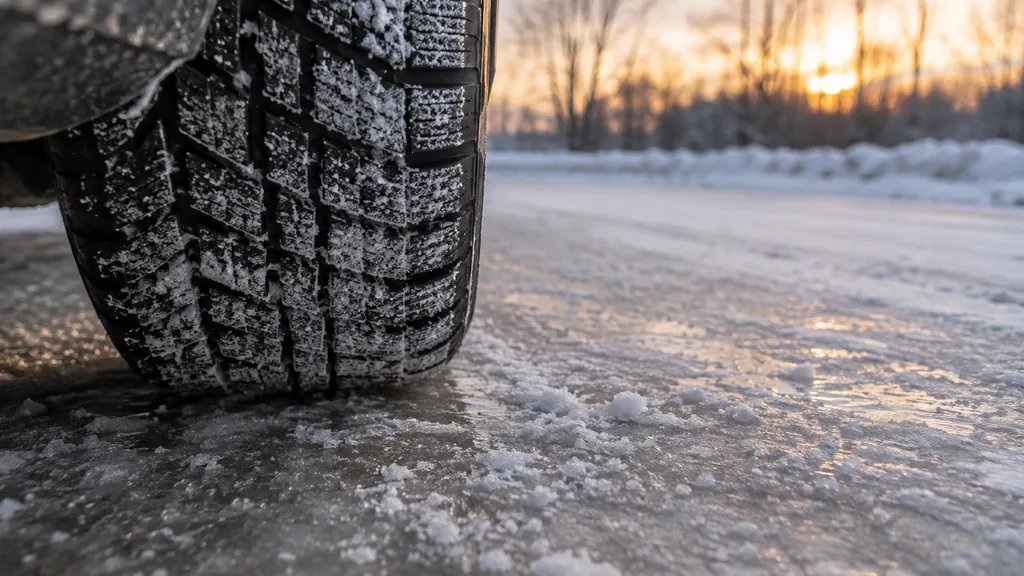
Three different tools, and only one of them is an ice test
People shop "winter tire," "all weather," and "studs" as if they were one product. They are three different claims.
| What you buy | What the mark actually is | What it is not |
|---|---|---|
| All weather with the snowflake | The three peak mountain snowflake is USTMA's severe snow mark, a packed snow traction test | Not the ice grip test |
| Studless winter tire with the ice grip symbol | Snowflake, plus M+S, plus a mountain with three icicles. USTMA's threshold is an Ice Grip Index of at least 1.18 under ISO 19447 | Not a year round summer tire. Europe's label rule says to keep it for very severe cold |
| Studded winter tire | A winter tire with metal studs. Grip depends on the studs still standing proud of the rubber, and on whether your state allows them that month | Not legal all year in Washington. Not a chain substitute on a pass that posts chains |
NHTSA still draws the coarse line: winter tires are more effective than all season tires in deep snow, and summer tires are not designed for temperatures below freezing or for snow and ice. That sentence does not tell studs from a snowflake. The rest of this page is the finer split, from documents opened 20 November 2026.
What the ice grip symbol requires
USTMA TISB 56, the July 2022 bulletin on passenger tires for ice, says those tires give better ice performance in addition to meeting the severe snow definition. Manufacturers recognize them when they reach an Ice Grip Index equal to or greater than 1.18 compared with the 16 inch Standard Reference Test Tire in ASTM F2493, using ISO 19447:2021. ISO's public abstract says that standard is the method for the relative ice grip index of a new passenger car tire on ice, and that it does not cover T type temporary spare tires. The full method is a paid standard. We are citing the scope ISO prints for free, and the threshold USTMA prints, not a copy of the lab procedure.
The same bulletin says the tire qualifies for M+S, the mountain and snowflake, and a mountain with ice. The ice mountain has a minimum base of 15 mm and a minimum height of 13 mm, and three icicles with the middle one the longest. USTMA says that pictograph and those dimensions are set in UN ECE Regulation No. 117.
European Regulation 2020/740 puts an ice grip pictogram on the tire label when the tire meets the minimum ice grip index, and it tells suppliers to say that ice grip tires are designed for ice and compact snow and should be used in very severe cold. Using them in less severe conditions, including wet roads or warmer temperatures, could mean weaker wet grip, handling and wear. That is a European label rule, not a U.S. ban. It is the clearest official warning we found that an ice tire is a seasonal tool, not an all year upgrade. The snowflake all weather tire is the one set option. The comparison is all weather vs all season.
Studs, with the dates on the research
A U.S. Forest Service tech tip from the Missoula Technology and Development Center compares studded tires, studless winter tires and all season tires for fleet managers. It says studded tires can offer the best ice traction of the three if the studs are not worn out, and that they increase stopping distance on wet and dry pavement because less rubber touches the road. It says the stud advantage may be lost in as little as 5,000 miles. It says studded tires may fit roads that are primarily ice, while studless winter tires may fit roads that are primarily snow with patches of ice. It says tires with the severe snow symbol have been performance tested for snow, and that all season tires perform poorly on ice and packed snow. It says to install a matched set of four rather than two. It also says studs damage pavement, add noise, and are prohibited in some states.
That tech tip is a summary for fleet buyers, not a 2026 instrumented test of a tire you can buy this week. An older state review is even more explicit about its age. The Washington State DOT research report of October 2002, "An Overview of Studded and Studless Tire Traction and Safety," concluded that studded tires did their best on snow or ice near freezing and lost more of their traction as the temperature dropped than studless tires did. It said the traction benefit over the studless tires in the studies it reviewed showed up mainly on clear ice near the freezing mark, and that where studs were better the gain was usually small. Twenty four years of tire compounds sit between that report and a tire molded this year. Use it as a reason to doubt slogans, not as a current ranking.
Washington's calendar, and why this page will not print a 50 state table
State stud rules change, and a blog roundup is how a wrong date gets copied. The only DOT page we are willing to state as a calendar is Washington's. WSDOT's release of 30 March 2026 says studded tires are legal from November 1 through March 31. There is no individual exception and no out of state waiver. Beginning April 1, the Washington State Patrol may ticket drivers still on studs. WSDOT does not write the tickets. State law lets WSDOT extend the deadline. That release said late snow was still possible in the passes, and that conditions did not support a statewide extension.
The same release quotes WSDOT maintenance manager James Morin that studded tires cause between $20 million and $29 million in damage to state owned roads each winter, on top of city and county roads, and it encourages non stud winter tread tires. It also says Washington and Oregon share the March 31 removal deadline, and that other states may not. If you are not in Washington, open that state's DOT page before you leave the studs on. We are not filling in the other 48 from memory.
NHTSA's winter page, read the same day, puts a scale on the season: in 2024 there were 365 fatal crashes and an estimated 24,383 injury crashes in snow or sleet conditions, and an estimated 131,698 police reported crashes during snow or sleet. The page says to consider snow tires, to keep tread at least 2/32 inch, and to set pressure from the door label because pressure falls as the temperature falls. It does not rank studs against the ice grip symbol. Our winter tire guide is the storage and symbol companion.
All four, including on all wheel drive
The USTMA care guide says that if winter tires are applied to the front axle they must also be installed on the rear, and that this applies to front wheel drive, four wheel drive and all wheel drive. Do not put a studded or ice grip pair on the drive axle and leave all season tires on the other end. On an all wheel drive car the set also has to match in circumference and wear, which is the whole point of which tire for an AWD car. A new ice tire beside three half worn all season tires is a diameter problem and a grip problem at the same time.
NHTSA's 2024 counts are crashes in snow or sleet, not a claim that a particular tire would have prevented them. Have a licensed installer mount the set. We have not tested studs, ice grip tires, or all weather tires against each other.
Frequently asked questions
Is the three peak mountain snowflake an ice rating?
No. USTMA's severe snow definition is a packed snow test. The ice grip symbol is an extra mark. USTMA says a passenger tire designed for ice meets that snow definition and also reaches an Ice Grip Index of at least 1.18 against a reference tire, using ISO 19447.
What does the ice grip symbol look like?
USTMA describes a mountain with a minimum base of 15 mm and a minimum height of 13 mm, containing three icicles, the middle one the longest. The tire also carries M+S and the snowflake. The bulletin points to UN ECE Regulation No. 117 for the pictograph.
Are studded tires better on ice?
Not as a blanket rule. A U.S. Forest Service tech tip says studs can help on ice while they are not worn out, and that they lengthen stops on wet and dry pavement. A 2002 Washington State DOT research overview found the stud advantage over studless winter tires mainly on clear ice near freezing, and said the gain was usually small. Both documents are older than a new tire test. Read them as dated reviews, and read your state DOT for whether studs are even legal.
When can I use studs in Washington?
WSDOT's 30 March 2026 release says studded tires are legal from November 1 through March 31, with no individual exception and no out of state waiver. The Washington State Patrol may ticket starting April 1. WSDOT can extend the window. That release said conditions did not support a statewide extension. Other states differ. WSDOT noted that Oregon shares the March 31 removal date.
Do I need the ice tire on all four wheels?
Yes if you are fitting a winter set. USTMA says winter tires on the front axle must also be on the rear, including all wheel drive. An all wheel drive car also has to keep circumference and wear matched. See the AWD page.
Sources
We paraphrase public references and link them so you can read the full wording. Pages dated below were opened 20 November 2026. We did not test any tire for this page.
- USTMA TISB 56 (July 2022): Ice Grip Index of at least 1.18 versus the ASTM F2493 16 inch reference tire under ISO 19447; symbol size; M+S and the snowflake as well (read 20 November 2026)
- ISO 19447:2021: scope of the ice grip method for new passenger car tires, excluding T type temporary spares (abstract read 20 November 2026)
- Regulation (EU) 2020/740: ice grip pictogram on the label; ice grip tires are for ice and compact snow and for very severe cold (read 20 November 2026)
- U.S. Forest Service, Missoula Technology and Development Center tech tip: studded, studless and all season comparison, including wet and dry stops and a matched set of four (read 20 November 2026)
- WSDOT research report, October 2002: stud advantage mainly on clear ice near freezing; dated review, not a 2026 test (read 20 November 2026)
- WSDOT, 30 March 2026: studs legal November 1 through March 31; no waiver; damage estimate; Oregon shares the March 31 removal date (read 20 November 2026)
- NHTSA winter driving tips: 2024 snow and sleet crash counts; consider snow tires; 2/32 inch; door label pressure (read 20 November 2026)
- NHTSA TireWise: winter tires more effective than all season tires in deep snow; summer tires not for freezing weather or for snow and ice (read 20 November 2026)
- USTMA Tire Care and Safety Guide: winter tires on the front require winter tires on the rear, including all wheel drive (read 20 November 2026)
- Image policy: how the AI generated photo is labeled